Chambers at Large in Kenya (2): The Equator, Thomson Falls and Lake Nakuru
Updated: Jan 24

I’ve crossed the equator a few times when travelling, but never actually stood on it. In Kenya I had the opportunity to stand astride the invisible line that divides the northern hemisphere from the southern and bought a certificate to prove it!
A young man called Charles was earning a few dollars by demonstrating the Coriolis Effect, which shows air and water is deflected to the right in the northern hemisphere, to the left in the southern hemisphere. However, when directly ON the equator the water is not deflected in either direction. His simple experiment was a treat and, as he was going to college to improve his English, (he wants to be a tour guide), I gave him a couple of dollars for the two-minute demonstration. Apologies for the poor quality of the video, but I was enthralled and was watching the demo, not concentrating on my camera.

Travelling from Aberdare National Park to Lake Nakuru National Park meant passing through a few very animated towns, but even in the countryside people were busy, selling their wares, minding their animals, or working in the fields. As we drove further south into the Great Rift Valley the quality of the land improved, the farms became bigger and bigger and a plethora of crops from mangoes to bananas to maize were being harvested.

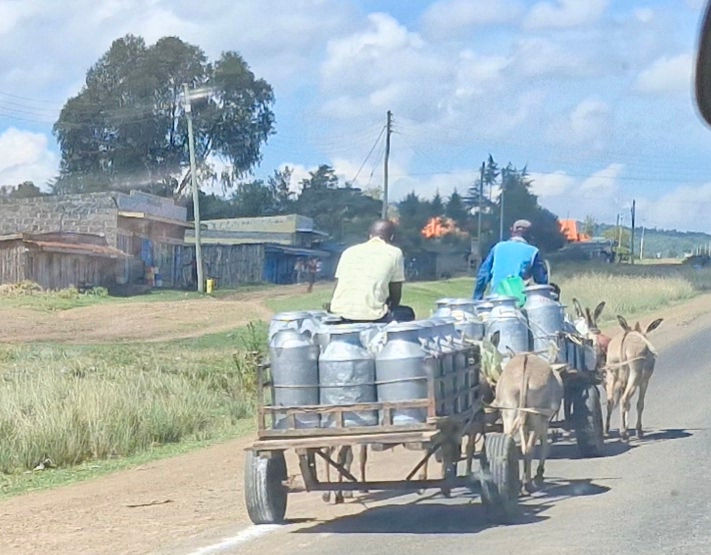
To my surprise, much of the work is still done by hand, however I was told, and I saw for myself, that the people worked in groups, therefore, clearing fields of crops such as maize quite quickly. I spotted the occasional tractor, a good old Massey Ferguson, and saw a man and child driving a donkey and cart laden with several churns of milk on the back. It reminded me of my childhood days in Ireland back in the 1960s.
The condition of the roads varied. Nothing is completely finished, not in the same way Europeans complete a road. There are numerous speed bumps, which I’m quite sure are not particularly effective, and the potholes varied in size from rabbit burrows to lunar craters.

Petrol stations and car showrooms are the two places that seem to take care of their outward appearance, many having kerb stones and landscaped garden displays at the entrance to the forecourt. Other shops are located on the dusty roadway, some made of corrugated iron others brick, but many are wooden stalls selling local produce.

An awful lot of people tend to be standing or sitting around, and I was informed that the unemployment in Kenya, especially for young people, is reasonably high. But I came to wonder how much Kenyans need by way of living expenses. Considering the amount of money the people in the West spend on houses, the Kenyans don't seem to invest in huge accommodations, preferring to live much more simply. Although when we reached Thomson Falls, there was a mansion overlooking the rushing water, which seemed to my mind a little excessive.

Thomson Falls, named after the Scottish geologist and explorer Joseph Thomson, is created via a swamp, which seems incredible considering the amount of water that falls several metres into a river, which finds its way into the Indian Ocean. A number of women, brightly dressed with elaborate hairstyles, acted as guides and I chatted with several, later learning they spend two hours or so each morning doing their hair. I felt a little badly I hadn’t taken a photo with them, but they were very cheerful and willing to laugh and chat, a natural trait of many of the local people I met.

My travelling colleagues and I arrived at the Sarova Hotel at Lake Nakuru around midday, and I have to say a big thank you to the receptionist. She took one look at us weary travellers and changed our rooms to rooms nearer the facilities, and by that, I mean the bar!

We went on two game safaris in Lake Nakuru National Park and much to my delight we came close to a number of animals including a rhino with her young calf. He ran alongside her on his stubby little legs, his head almost half the size of his body.

We found prides of lions lying near the roadside, the lionesses very protective of their cubs, keeping them out of sight and cool in the longer grass.

The lake was glorious in the early morning sunshine, and I took a few photographs of the acacia trees which, I was told, fell in heavy weather as there is no real taproot. Sadly, the waters have risen considerably and one can no longer drive around it.

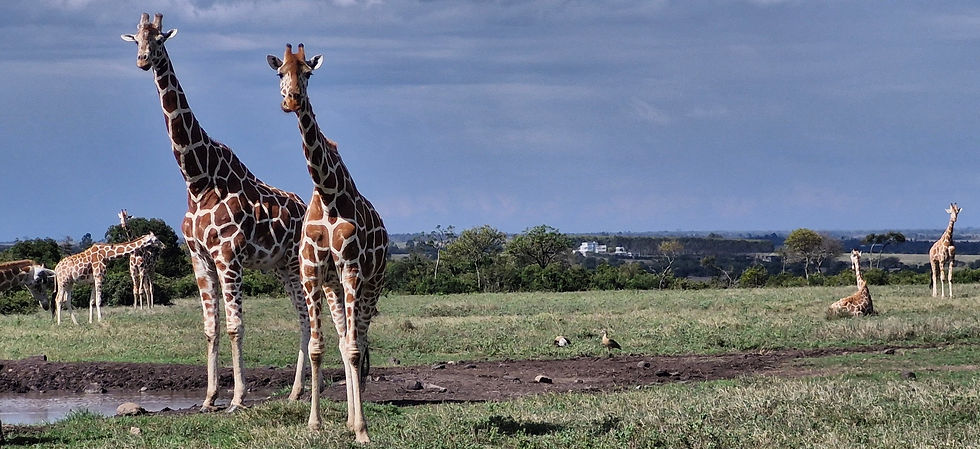
We were treated to a tremendous display of birds by the lake shore, including pelicans, storks, cormorants, flamingo, and teal. Our guide told us that they were red teal and blue teal, white necked cormorants and black necked cormorants and I accused him of making up the blatantly obvious names. (I have to say the Victorian explorers weren’t exactly imaginative when it came to nomenclature!) What is far more fun are collective nouns. A tower of giraffe, a dazzle or zebra and an embarrassment of pandas. So, was it a flock of pelicans or a plethora or a pantheon? I later discovered it’s a pod, but when in flight, a squadron.

Cape buffalo grazed under the trees, as did the spectacularly horned waterbuck, and baboons scampered along the roadside, but the joke that morning was we had to stop for a real zebra crossing!
My stay at Lake Nakuru was fabulous. A big thank you to all at the Sarova Hotel and to my travelling companions who were just amazing company.

However, it was time to move on to Lake Naivasha and Crescent Island, which I will tell you all about in my next blog.
***
My other blogs regarding Kenya can be accessed by clicking on these links:
But if you are a bit of an animal lover you may enjoy my blog telling of my tiger safari in India earlier in the year. Please click on the link to discover more.
Thanks for reading.


Great as usual very informative