
Chambers at Large in Kochi, Kerala, India
Friends recommended I visit the state of Kerala in south west India as it is very different to north India and its cities of Delhi, Jaipur and Amritsar, which I visited last year.

I flew into Kochi airport, which is solar powered, and was immediately struck by how much cleaner the streets were, that there were coloured cars, (not a sea of monochrome black and white) and there were no cows wandering the streets. The reason why became apparent as my stay progressed.

Kerala has a wealthy and very educated population. Young Keralites leave home, work abroad, then send money home, allowing family to build large properties, or live in plush apartments on the shores of the rivers, and there are many in the area. Ninety-nine percent of Keralites are literate, many speak English and much of the signage on shops, banks, and billboards is in English. Life expectancy is higher here and child mortality is the lowest in India thanks to an erudite appreciation of healthcare.

Kerala is vibrantly green thanks to the tropical climate and the streets of Kochi boast a number of trees, some hundreds of years old. These are home to flocks of birds: herons, egrets, ravens or crows (maybe blackbirds) and pigeons, all of which forage around the waters which lead into the Arabian Sea.

My guide pointed out an old rain tree, so called because its branches spread out, like an umbrella. The leaves curl up at night trapping any rainwater, but beware in the morning as when the leaves open you may be subjected to an unexpected shower!

The buildings, nestled under the verdant foliage, have red tiled roofs and were built by the Dutch or the Portuguese. Many are hotels, country clubs, and government offices. One particular establishment was where celebrities featured in the reality show: The Marigold Hotel (not the movie) and I can understand why Kerala was chosen as a base, as it’s almost home from home.

The Portuguese have a left quite a legacy, as have the Dutch and the British. It is thought the Portuguese brought syphilis to India as it is known as the Portuguese disease, but on a more positive note, many fruits and vegetables were shipped from South America as well as rubber trees, A parade ground once used by the British military is now a soccer pitch, soccer being the popular sport among young people, almost overtaking cricket.

The church of St Francis was the first European church built by Portuguese friars in the 16th century. To my surprise, it was here where Vasco da Gama, the Portuguese circumnavigator, was once interred. (He was later disinterred and his remains now rest in Lisbon.)

A square named after him sits by the estuary where people were selling trinkets to tourists, but a fish market runs alongside where fishermen were selling sea bass, snapper, lobsters, jumbo prawns, jumbo shrimp and calamari. Sea birds hovered nearby hoping to snatch a fish head or two but, to my astonishment, I didn’t see any cats.

The fisherman catch their haul using Chinese nets which work on a cantilever system. The entire apparatus is lowered into the water and retrieved five to ten minutes later, hopefully with a good catch. This has been successfully practised for hundreds of years and not likely to change any time soon. If it’s not broken, don’t fix it.

Walking through the old town I was shown a government store which sells subsidised provisions. Families are issued a ration card and can avail of one item per month at a reduced rate. Wealthy families probably do not use their card out of a sense of pride, or possibly altruism, but for many the store ensures people can get basic foodstuffs such as cooking oil which is expensive. It can cost a family a quarter of their daily income.

The caste system in Kerala has changed drastically in recent years. A laundry, set up by the Dutch as far back as 1792, is run by what were once called the Untouchables, but are now called the Dalits, proved to be a highlight of the day. The work is arduous, done by hand, and as the men use harsh detergents and soap to clean the laundry their skin suffers. However, the men work as a cooperative and earn a fair wage.

The laundry is washed, beaten against a stone rock, then rinsed. It is hung out to dry in the sunshine on a twisted rope line without the need for pegs. Small rugs or carpets are laid out on the lawn and ,due to the 30 degree heat at midday, the drying process doesn’t take long.

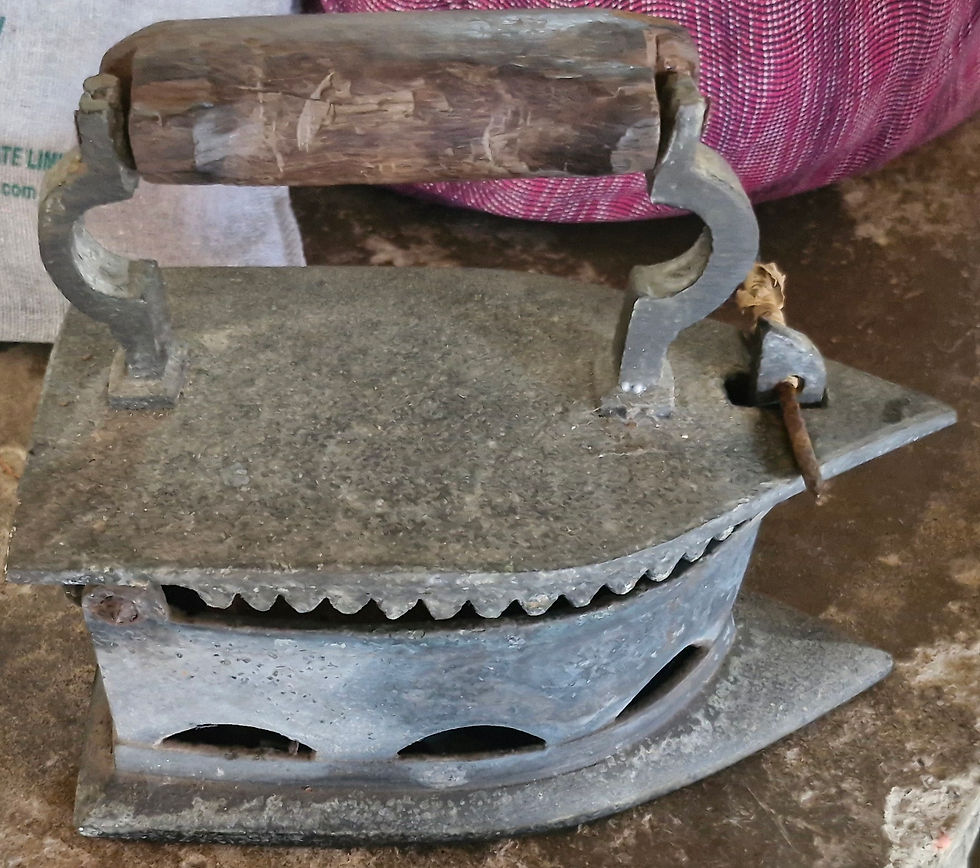
The laundry is then ironed and one gentleman was using to what I recognised as an iron the Victorians would have used. An iron heated by burning coconut husks in the lower chamber. However, another gentleman was using an electric iron, which weighed 9 kg. I could barely pick it up, let alone use it.
One of the men showing us how to put on a dhoti, explained that his two sons were working elsewhere and would not be following in his footsteps, which would have been expected years before.

It was a Dalit who went about reforming the caste system. With the impressive full title of Bharat Ratna Babasaheb Dr B R Ambedkar this man became one of the most respected men in India. He was one of the most intelligent students at school, even though he wasn’t accepted by the other boys. He was not allowed to touch the chalk, not allowed to eat at the same table, not allowed to even sit on the same chairs, but he ended up going to Colombia University in the US, then onto the London School of Economics. He eventually received one of the highest honours in India and seemingly there are more statues of this remarkable man than there are of Mahatma Gandhi, although nearly every town has an MG Street.

The last stop of the morning was Mattanchery Dutch Palace, which is now a museum. On display were coins, weaponry and sedan carriages, which looked to me more like funeral coffins. Women of notable birth were carried in these when they went out into the streets in order to remain hidden from the general populous. They reclined in these boxes, which were carried by four to six soldiers. They all looked damned uncomfortable, even one inlaid with ivory. All I can surmise is that people had to be about four foot six in height as I can’t see an Alsatian dog fitting in one nowadays.

Costumes worn by the noble women were on display and shown in photographs. They were expected to wear a white top and skirt made of pure cotton, which had to be cool in the hot sun, but all the women look the same.

There was plenty to learn about Indian history but the building itself was beautifully decorated with wooden roofs carved into which were lotus blossoms. A mural told the tale of a prince who having lost his wife and his palace was exiled into the forest. The story then involved battles, demons, ten headed gods, monkeys, a few elephants but ended Happily Ever After. I’d like to be able to tell you more, but I was becoming tired after my journey and my old brain was shutting down, however the frescoes were stunning.

My first day in the state of Kerala was a success and I’m glad my friends suggested I visit. I certainly had more to look forward to which I will write about in subsequent blogs.
Thanks for reading and safe travels.
***
I’ve found India to be a fascinating country and I’ve been there three times. You can read about my exploration via these links:

Not forgetting the most amazing safari in May 2025 when I was delighted to see leopards, guar, as well as tigers.


What a wonderful introduction and insight into the State of Kerala , looking forward to reading more on the rest of this India trip